
Criminal Cases in Orange County Courts
Orange County criminal cases do not all sit in one office. Orange Supreme and County Court at 285 Main Street in Goshen handles superior criminal matters, including felony prosecutions. City courts in Middletown, Newburgh, and Port Jervis hear misdemeanors and lesser offenses. They also conduct the first arraignment on a felony complaint. Town and village justice courts handle local misdemeanors, violations, vehicle matters, and felony arraignments within their own borders.
The clerk for the court of origin keeps that court's file. The Orange County Clerk Record Room maintains filed Supreme and County Court actions, while a city, town, or village clerk keeps its local docket. The court name and case number are the key routing facts. A person seeking a certificate of disposition for a Newburgh misdemeanor should not assume the County Clerk has it. Likewise, an archived superior-court felony file belongs at the Orange County Clerk rather than the Sheriff's Office.
Orange County Court Records at Two Counters
Goshen has a local trap for court-record searchers. Courtroom operations, current calendars, and superior-court administration are at 285 Main Street. Filed Supreme and County Court actions, public search computers, copies, and archived felony files are at the Orange County Clerk Record Room, 255 Main Street. Both counters operate Monday through Friday from 9 a.m. to 5 p.m., but they do different work.
Orange County Clerk Record Room
255 Main Street
Goshen, NY 10924
845-291-4000
Criminal-form help: 845-291-3080
Orange Supreme and County Court
285 Main Street
Goshen, NY 10924
845-476-3500
Monday-Friday, 9 a.m.-5 p.m.
The Record Room offers free public computers for onsite searching. It also provides plain and certified copies. The Orange County courthouse posts daily and weekly calendars and links to WebCrims. Treating the two Orange County sites as separate stops saves a failed trip and gets an Orange County criminal case request to the custodian that can act on it.
How to Search Case Records
eCourts WebCrims is the free first stop for pending Orange County criminal court cases and future appearances in covered courts. It accepts a defendant-name search or a direct case-number search. An Orange County name result is only a match lead, so compare the court and docket before relying on it. For Orange County, WebCrims does not provide every filed document, sealed cases, or a complete historical record.
- Open WebCrims and choose the defendant or case-number route.
- Enter the legal surname and add the first or middle name when needed.
- Select Orange County or the known court to reduce unrelated matches.
- Record the case number, court, status, charge, and next appearance shown.
- Call the named clerk to confirm the entry and request filed or certified documents.
| Field Label | Type | Required | Notes |
|---|---|---|---|
| Defendant Last Name | Text | Yes for name route | Spelling must match the filed name |
| First and Middle Name | Text | No | Useful for common surnames |
| County | Dropdown | No | Select Orange for local results |
| Court | Dropdown | No | Options depend on county coverage |
| Case Number | Text | Yes for case route | Use the court-format docket number |
Why 1993 Changes Orange County Case Searches
Older Orange County criminal case files need a different path. The County Clerk identifies archived Supreme criminal files from 1902 through 1984, and its criminal-record request form applies a year-by-year search charge to files before 1993. A broad span can therefore cost more than a request tied to a known filing year. Orange County searchers should first narrow the likely date through family papers, a docket reference, or the court of origin.
The Orange County pre-1993 search rate is $2.50 per year. Plain Record Room copies cost $0.65 per page with a $1.30 minimum. Certified copies cost $1.25 per page with a $5 minimum. On a mailed request, the Clerk instructs users to include a self-addressed stamped envelope and a check or money order payable to Orange County Clerk marked "Not to exceed $50.00." The form goes to Court Papers at 255 Main Street.
Note: WebCrims silence does not rule out an older Orange County case file or a docket held by a local court.
What the Case File Shows
An Orange County criminal case file tracks what happened after an accusation reached court. It can include the accusatory instrument, later indictment or superior-court information, appearances, motions, orders, plea or trial result, judgment, and sentence. The docket is the index to those events, not a substitute for the filed papers. WebCrims often shows useful fields but generally does not supply downloadable pleadings. Ask the clerk for the exact document or a certificate of disposition.
| Case Number and Court | Identifies the docket and the clerk that holds the originating file. |
|---|---|
| Charging Document | States the accusation filed in court, which can differ from an arrest charge. |
| Docket Entries | Chronological record of appearances, motions, orders, and filed events. |
| Hearing Dates | Past appearances and, for a pending case, the next date and court part. |
| Disposition and Judgment | Shows dismissal, acquittal, plea, trial conviction, or another final result. |
| Sentence and Conditions | Records jail, prison, probation, fine, or other terms imposed after conviction. |
Read Orange County Charges and Outcomes Separately
Three fields answer three distinct questions. The arrest charge states what an officer alleged at custody. The filed charge states what prosecutors brought before the court. The disposition states how the court resolved a count. A sentence appears only after a conviction and does not turn an earlier, dismissed count into a conviction. Reading all fields together prevents a common Orange County record error.
- Arraignment
- The first court appearance where charges are addressed and release or bail can be considered.
- Disposition
- The result of a charge, such as dismissal, acquittal, plea, conviction, or other court action.
- Certificate of disposition
- The originating court's official statement of how one case ended.
- Sealed
- Restricted from public view under a New York sealing law, not necessarily destroyed.
If a docket and a fingerprint-based personal record disagree, obtain the certificate from the court that decided the case. Compare it with an unsuppressed DCJS Personal Record Review, then follow DCJS correction instructions. A public CHRS result is not a fingerprint match and cannot replace that self-review process.
Stages of a Criminal Case
An Orange County criminal court case can begin with an arrest or an appearance ticket. A local court conducts arraignment and addresses release or bail. A felony complaint may then move through a grand-jury indictment or superior-court information to Supreme or County Court in Goshen. Discovery, motions, hearings, a plea or trial, disposition, and sentence follow as the case requires. New York law calls for an arrested person to be brought before a local criminal court without unnecessary delay, but the research provides no fixed Orange timetable for later stages.
Case flow: Charges Filed › Arraignment › Pretrial › Plea or Trial › Disposition › Sentencing
A dismissal, acquittal, violation outcome, adjournment in contemplation of dismissal, or conviction has a different meaning. The docket label and sealing status must be read together. For a deeper distinction between the custody event and filed charges, consult the Orange County arrest history record page.
Orange County Felonies Move to Goshen
A felony complaint can begin in Middletown, Newburgh, Port Jervis, or another local justice court. That first court handles arraignment and the early docket. If the prosecution proceeds by indictment or superior-court information, the Orange County felony case moves to Orange Supreme or County Court in Goshen. The case therefore can have a local-court number and a later superior-court file.
Keep both Orange County court names when tracing the record. The local clerk can answer questions about its arraignment file, while the County Clerk holds filed Supreme and County Court actions. A misdemeanor or lesser offense may never make that transfer. WebCrims can reveal the court currently assigned, but the clerk should confirm which office holds the requested paper.
Orange County Certificates Versus CHRS Results
The OCA Criminal History Record Search costs $95 for each exact name and date-of-birth combination. It reports qualifying open cases and convictions from New York courts, but it is noncertified. Alternate names or birth dates require separate paid searches. Town and village data also have historical gaps, including no reported data from May 1991 through 2002 and limited reporting until May 2007.
A certificate of disposition is different. It comes from the court where one case ended and serves as the court's official statement of that outcome. The Orange County Clerk can issue certificates for its Supreme and County Court files, while local clerks handle their own cases. Use CHRS to cast a statewide exact-name net. Use the certificate when the exact Orange County case result matters.
The successful manifest image comes from the Orange County Clerk court-records page.
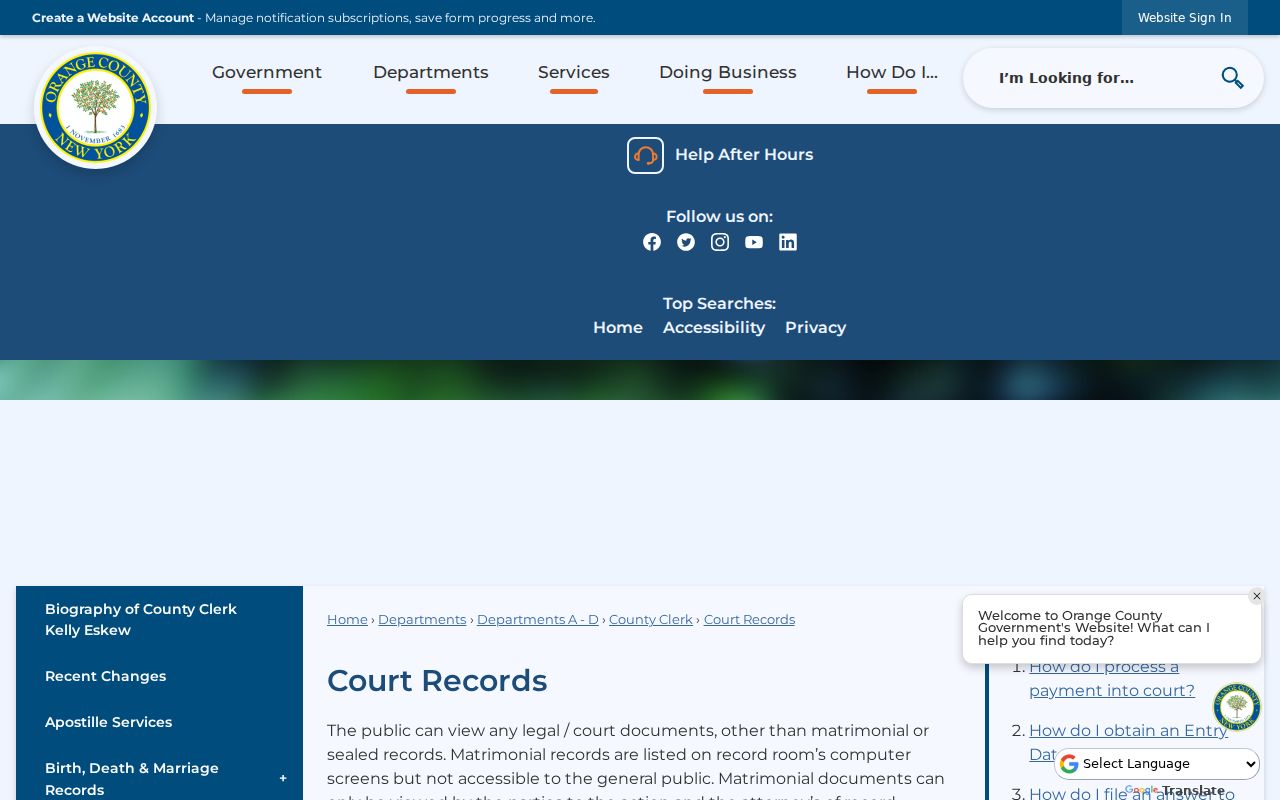
That official route directs searchers toward the criminal-record request process rather than treating an online result as a certified court file.
Access & Restrictions
Public access does not make every Orange County criminal record open. Favorable outcomes ordinarily seal under CPL 160.50, and specified violation outcomes can seal under CPL 160.55. Youthful-offender records are confidential. Victim identifiers, information about minors, medical details, Social Security numbers, and facts that could interfere with an active case may be removed or withheld. New York FOIL does not override those court-sealing laws.
A missing public result can mean sealing, a spelling mismatch, a local-court reporting gap, or an unreported event. Ask the named clerk before drawing a conclusion.
The Orange County Clerk's public computers allow free onsite searching of open records. Fragile older papers may have handling limits. At the courthouse, visitors pass through a magnetometer; municipal and accessible parking are available, and court-system accommodations can be requested in advance. These access details matter when WebCrims identifies a case but the needed filing exists only at a counter.